
Flaco’s Story
In February 2024, a Eurasian Eagle owl named Flaco died at the age of thirteen in New York City. This owl captivated birdwatchers and passersby alike after escaping from the Central Park Zoo in early 2023. Despite his sudden introduction to life in the wild, however, this owl did not die of starvation or a vehicle accident; he died of poisoning from SGARs, or Second Generation Anticoagulant Rodenticides, a commonly used rat poison. But how could it be that such a famous and beloved owl died of a chemical that is completely legal to use in the presence of raptors, dogs, and children?
This is not a problem unique to New York City. I have been sad to notice a decline of raptors in my neighborhood of Brookline and even a corpse of a red tailed hawk on a street nearby. A large number of raptor deaths in the state of Massachusetts, unfortunately, occur from SGARs. The prevalence of these rat killing (and raptor killing) chemicals is so dangerous to these creatures and the entire food chain- but luckily, this damage is easily preventable.
SGARs: What Are They?
Second Generation Anticoagulant Rodenticides, commonly written as SGARs, are rodenticides that work through preventing the target pest from employing Vitamin K to properly clot blood. This causes internal bleeding and death for rodents. Only a minimal intake of the poison can cause a fatality, hence their use is still so widespread despite government acknowledgements of these chemicals’ hazardous nature. However efficiently SGARs work on rats and mice, the harm SGARs do to the ecosystem far outweighs the benefits of this flawed method of pest control. SGARs kill rodents in approximately five to ten days, leaving ample time for ingestion by animals that prey on the poisoned rodents. The predators that control populations of the rodents in their natural environment are then killed, leaving devastating food chain changes that alter the natural balances that keep an ecosystem working as it should. Through these dramatic changes, the population of predators such as eagles, hawks, and owls can be permanently impacted in addition to the efficiency of this pest management system being greatly reduced. For example, a peer-reviewed study found that 82% of 300 studied eagles had anticoagulants in their bodies, with anticoagulants causing fatalities for 4% of eagles in the study.
You’ve probably seen the unremarkable black plastic boxes or fake rocks throughout the town of Brookline. Many of these contain the chemicals classified as SGARs, and it’s really quite shocking how frequently we walk by these without thinking about them whatsoever. See the attached picture below:
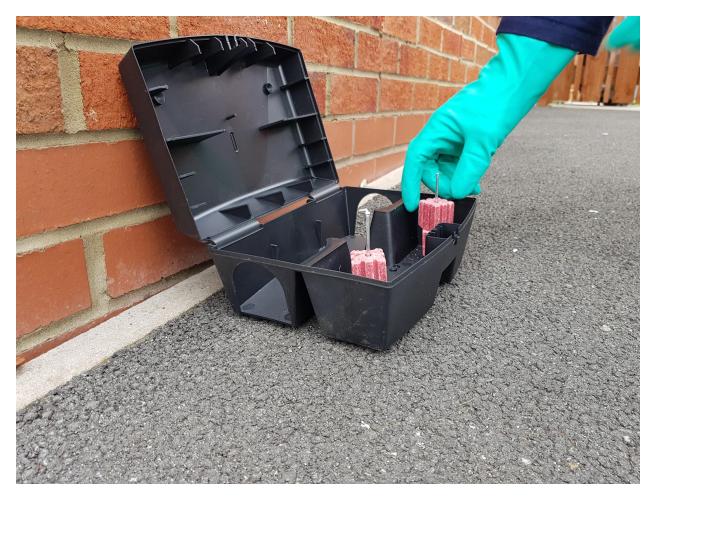
Source: Wikimedia
In addition, I’ve also noticed an unusual prevalence of rodents in Brookline on the sidewalks in broad daylight, which is not characteristic. Many of these mice or rats are unable to move. These animals are interspersed throughout yards and roads alike, trembling yet weakened so much they can’t run away. Whenever I walk my dog I have to keep an incredibly close lookout so as not to find him chasing a poisoned rat, or worse, attempting to eat a corpse. I’m quite confident that without my restraint he would have been poisoned a thousand times over.
It’s really horrible how quick we as humans are to jump to the simplest solution to any problem without thinking about the impact we have on other living creatures. Even if we aren’t consciously taking a part in destroying our native biodiversity, we still need to attempt to make it right and fix the damage we’ve done. Birds of prey play such an important role in the natural world and saving these majestic and awe-inspiring animals should be a higher priority.
What Can We Do?
One of the most frequent defenses of the continuation of SGARs is that they are the only form of pest control that are cost-efficient and effective. However, there are many other cheap and functional options to reduce your rodent problem without causing irreparable harm to the feathered friends in your neighborhood. First of all, any sort of lethal poison or trap may not even be necessary depending on your situation. The Santa Barbara Audubon Society cites three pest solutions that don’t require any traps: providing safe spaces and welcoming natural predators of your target pest, providing repellants and blocking possible entrances, and containing waste. In addition, rat contraceptives have been created and have shrunk populations to five percent of their usual amount when dosed incrementally, and live capture traps are extremely cheap and humane. Even if lethal methods are necessary, there are still good alternatives available as well. As long as inhumane traps like glue traps, which injure rats and mice and leave them to suffer for days until their death, are avoided, there are many options like electric traps and naturally sourced poisons.
How I Switched My Apartment Building to Raptor-Friendly Poisons
It is still unknown to the majority of property owners just how easy it is to help birds of prey in your choices of pest control. Additionally, most people don’t know what poisons are actually being used in their homes, or their drastic consequences. An abundance of natural and humane pest control solutions makes switching SGAR use easy; it only takes a small amount of time to switch the brand of your online order of bait or to ask your pest management company if they can switch what chemicals they use in your home. Be careful to avoid the chemicals brodifacoum, bromadialone, difenacoum, and difethialone for bait stations if you choose to use poison. Just these small switches to how you control pest problems on your property can make all of the difference for the wildlife in your community.
My apartment building quickly agreed to make the switch after being informed of the simplicity of changing traps/bait. We, like many apartments and homes, hire a pest control company to take care of providing traps for rodents in our building that uses SGARs as their default poison, and all it took was a mention to the board who then brought up the switch with the pest management company we use. For so much damage to the environment, it’s quite incredible how easily we can make changes to help our raptors here in Brookline!
Other sources:
https://www.apvma.gov.au/resources/frequently-searched-chemicals/rodenticides
 Friends of Brookline Raptors
Leave a comment